What Factors Determine the Success and Safety of Motiva Breast Augmentation at Apgujeong Station Plastic Surgery?
Why is Selecting the Right Implant and Clinic Near Apgujeong Station Crucial for Breast Augmentation?
For individuals considering breast reconstruction or aesthetic enhancement, achieving a natural shape and soft tactile feel represents the primary clinical goal. Many patients experience anxiety regarding post-operative complications such as capsular contracture, implant displacement, or an unnatural appearance when standing up versus lying down. Choosing a highly specialized plastic surgery clinic near Apgujeong Station ensures access to cutting-edge diagnostic equipment and experienced surgeons who can accurately assess anatomical limitations before selecting the surgical approach.
Treatment timing: Surgery is ideal when the patient’s breast tissue envelope elasticity is stable, typically after complete physical maturity or post-pregnancy tissue stabilization.
Non-surgical care: Conservative approaches such as posture correction, targeted physical therapy, or supportive brassieres are reasonable options when tissue laxity is minor and surgical risks outweigh aesthetic expectations.
Treatment selection: Clinical decisions must prioritize individual thoracic dimensions, breast parenchyma thickness, and lifestyle-related movement requirements over uniform sizing trends.

How Do Ergonomic Gel Dynamics and Surface Technology Protect Patient Safety?
To understand the clinical advantages of modern implants, one must examine the anatomical and pathophysiological mechanisms of breast tissue adaptation. Capsule formation is a natural physiological reaction where the body creates a fibrous tissue envelope around a foreign object, which can pathologically progress to painful capsular contracture if subclinical inflammation persists. Unlike traditional textured or smooth options, Motiva implants utilize a highly advanced SilkSurface nanotexture that optimizes biocompatibility and significantly reduces foreign body reactions.
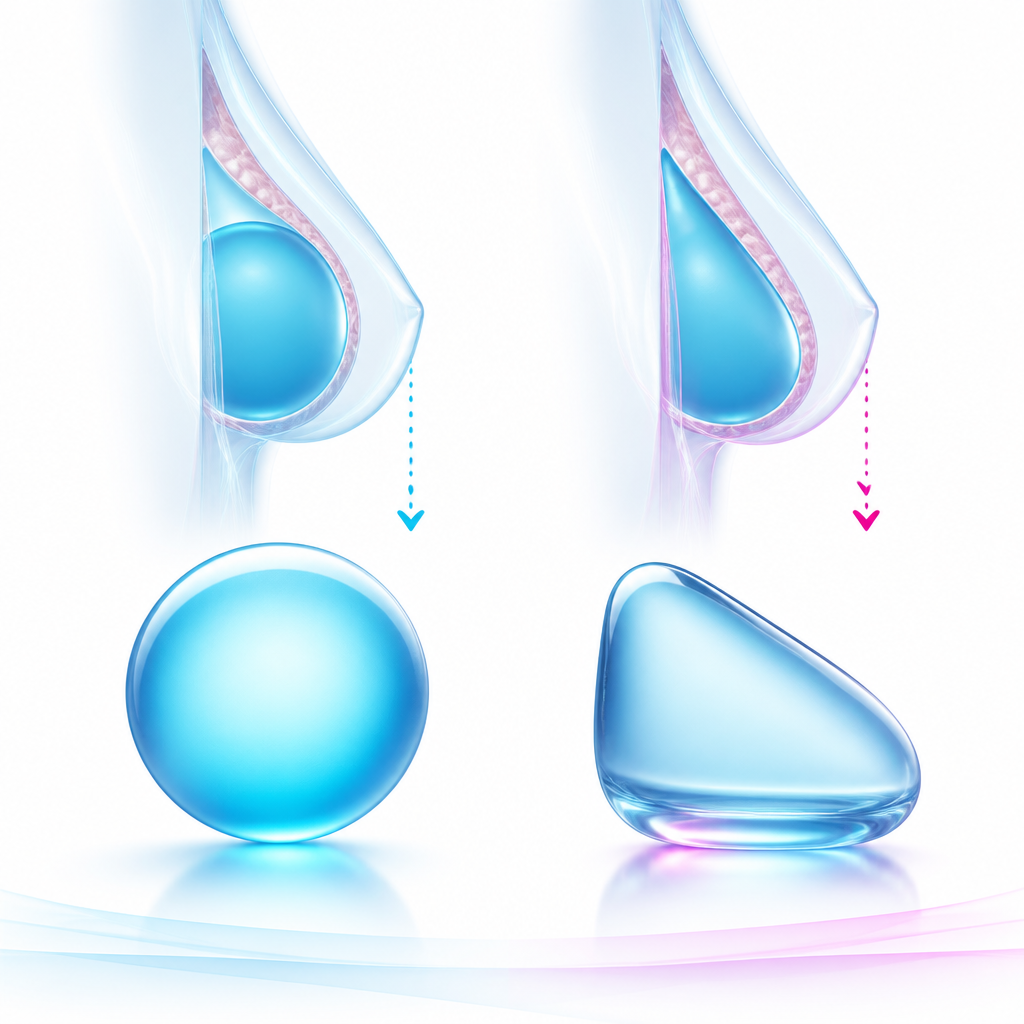
Furthermore, the cohesive gel inside the implant exhibit unique rheological properties. Under the influence of gravity, the gel shifts fluidly from a round profile when supine to a natural tear-drop shape when standing. This dynamic responsiveness mimics natural breast parenchyma movement, reducing mechanical stress on the surrounding tissue envelope.
| Feature | Motiva Ergonomix | Traditional Round Implants |
|---|---|---|
| Gel Behavior | Ergonomic shift (round to tear-drop based on gravity) | Fixed round shape regardless of position |
| Surface Texture | SilkSurface Nanotexture (low inflammation) | Macro-textured or smooth (varies by brand) |
| Main Advantage | Natural tactile sensation and minimal contracture risk | Predictable upper-pole fullness |
| Limitation | Higher initial material cost compared to standard gels | Increased risk of rippling and unnatural feel in thin skin |
According to clinical consensus guidelines published in the Aesthetic Surgery Journal (2021), both quantitative soft tissue measurements and careful clinical judgment regarding implant plane placement should be reviewed together to achieve long-term safety.
What Pre-operative Criteria Determine the Ideal Fit for Motiva Implants?
According to multiple observational studies and meta-analyses published in PubMed (2022), patients undergoing augmentation with highly cohesive ergonomic gels showed a capsular contracture rate of under 1.2% over a 5-year follow-up period. However, achieving these optimal statistics requires a rigorous evaluation of the patient’s individual anatomy, particularly when seeking specialized clinics near Apgujeong Station where high-end diagnostic tools are utilized. Surgeons must assess the thickness of the subglandular tissue, the degree of pre-existing chest wall asymmetry, and the diameter of the breast base.
When the overlying breast parenchyma is thin (less than 2cm), a dual-plane or submuscular placement is generally preferred to prevent implant visibility and edge-rippling. However, outcomes may differ in exceptional cases such as severe chest wall deformity, extreme tissue atrophy, or history of multiple radiation therapies where tissue elasticity is severely compromised.
- Ultrasound Tissue Evaluation: Measuring exact subcutaneous fat and glandular thickness to choose the surgical plane.
- Thoracic Dimension Matching: Ensuring the implant diameter does not exceed the natural breast base width to avoid lateral displacement.
- Biocompatibility Verification: Selecting nanotextured surfaces to minimize subclinical biofilm formation.
- Post-operative Monitoring: Planning routine high-resolution ultrasound checkups to verify implant integrity over time.
Decision-Making Flow for Surgical Planning:
- Step 1: Measure the pinch test thickness of the upper pole. If it is less than 2cm, select dual-plane insertion.
- Step 2: Evaluate the thoracic width and rib cage curvature to determine the maximum safe implant volume.
- Step 3: Confirm patient lifestyle factors. For highly active individuals, prioritize nanotextured cohesive gel to minimize rotational risks.
Frequently Asked Questions FAQ
QIs Motiva breast augmentation suitable for patients concerned about capsular contracture?
Yes. The SilkSurface nanotexture of Motiva implants is designed to mimic natural tissue biocompatibility, which has been shown in international clinical trials to dramatically decrease the inflammatory response and subsequent capsule thickening compared to older-generation textured surfaces.
QHow long is the recovery period before returning to daily activities?
Most patients resume light daily activities within 3 to 7 days post-surgery. However, strenuous physical exercise, heavy lifting, or upper-body workouts should be avoided for at least 4 to 6 weeks to ensure proper healing and prevent implant displacement.
QDoes the built-in microchip affect safety or security checks?
No. The Qid safety microchip is a passive radiofrequency identification (RFID) device that contains no personal data. It merely allows medical professionals to verify the implant serial number and specifications externally, and it is fully compatible with standard airport security and MRI scans.

This content is general medical information, and individual treatment decisions should be made through imaging tests and in-person medical evaluation.
Author: Medical content editor based on medical information research
Reviewed by: Specialist consultation from the relevant department
Last reviewed: 2026-07-27
Reference guideline: 2021 Aesthetic Surgery Journal Clinical Consensus
Medical neutrality and closing note
The core of medical decision-making is not to follow a specific device or a trending procedure, but to choose an option that fits each patient’s individual anatomy, condition, risk level, and treatment goals. Every procedure has both advantages and limitations, so decisions should be made after sufficient discussion with an experienced specialist.
[Medical information and copyright notice]
This content is a professional medical column prepared based on medical consultation from 제이케이성형외과의원.
The infographics used in this article are created to support understanding and may differ from actual clinical results.
The information provided is a general medical guideline, and accurate diagnosis and treatment require an in-person evaluation by a qualified specialist.