What Makes a Hairline Transplant Design Natural? Key Criteria for Avoiding an Artificial Forehead
Why Do Standard Hair Restoration Designs Often Fail to Look Organic?
Many patients seeking corrective hair restoration voice a common concern: the fear of ending up with a doll-like, unnaturally straight, or excessively dense forehead line. This unnatural appearance is rarely a consequence of poor graft health; rather, it is almost always a failure of the initial aesthetic planning and anatomical design. The human hairline is not a simple, uniform wall of hair. It is a highly complex, multi-layered transition zone that demands meticulous artistic and surgical planning. Failing to account for the facial skeletal structure, patient age progression, and natural hair groupings leads to results that look instantly artificial.
Treatment timing: Hairline correction is ideal when congenital forehead shape causes psychological distress or when progressive androgenetic alopecia has stabilized through medical therapy for at least 6 months.
Non-surgical care: Conservative management using topical minoxidil, oral 5-alpha reductase inhibitors, or scalp micro-pigmentation is reasonable for patients with early-stage hair thinning without distinct recession of the hairline margin.
Treatment selection: The choice between FUE and FUT depends on donor hair density, scalp elasticity, recovery expectations, and the total number of grafts required to achieve a natural gradient.
How Do Specialists Define the Anatomical Standards for a Perfect Hairline?
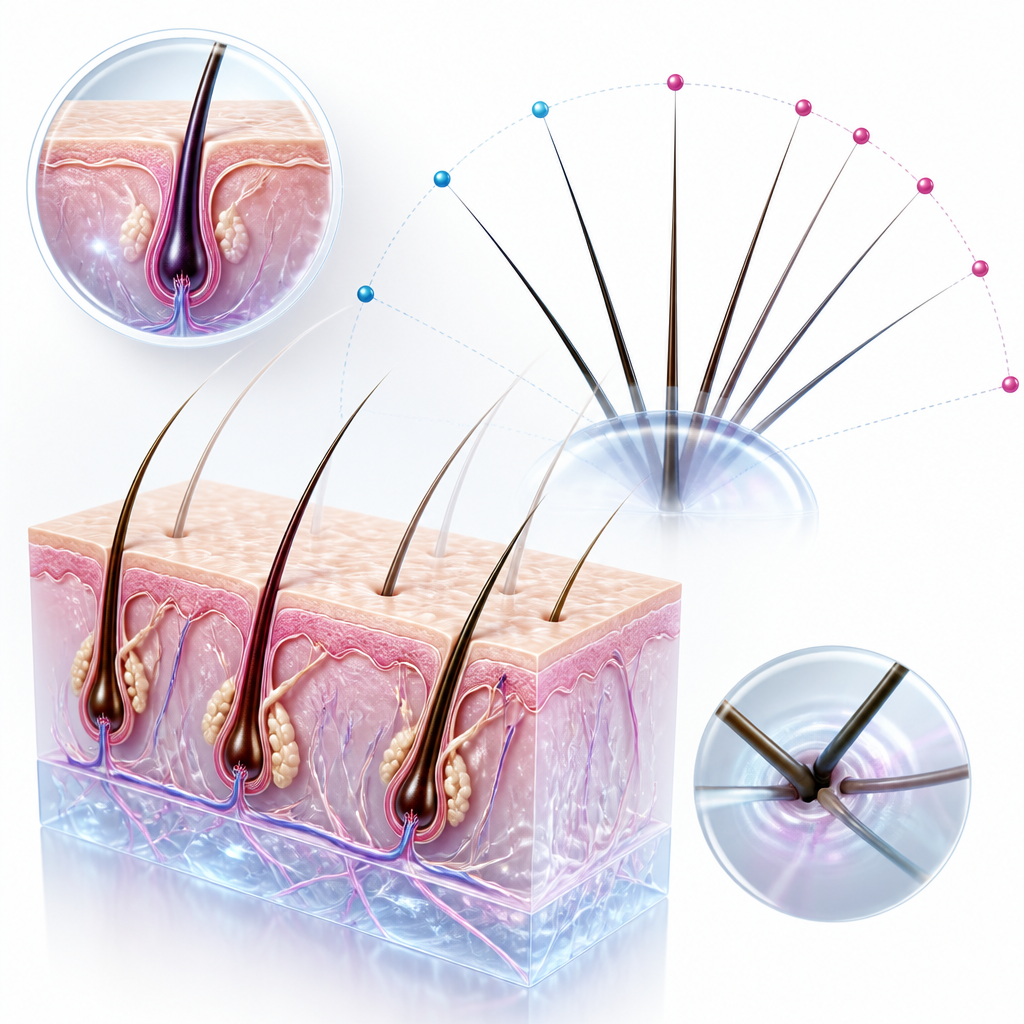
The forehead hairline is a complex transition zone defined by the frontotemporal recess, where hair follicles naturally transition from fine, single-hair units at the anterior margin to thick, multi-hair follicular units posteriorly, influenced by underlying frontalis muscle dynamics and progressive androgenic changes. This zone is heavily subject to ongoing hormonal influences, meaning a design that looks acceptable in a patient’s late twenties may appear highly incongruous as temporal recession continues into their forties and fifties. Therefore, an expert hairline design must anticipate lifetime facial maturing.
According to multiple observational studies and meta-analyses published in the Journal of Plastic and Reconstructive Surgery (2020), a successful hairline reconstruction should follow the golden ratio of facial aesthetics, dividing the face into three equal vertical segments: from the chin to the base of the nose, from the nose to the glabella, and from the glabella to the trichion. However, strictly adhering to mathematical averages can strip a patient’s face of its unique character. Modern plastic surgery design emphasizes custom contouring. The physician must analyze the direction of existing hair growth, the density of the donor site, and the specific motion of the frontalis muscle when the patient expresses emotion to avoid creating a line that looks frozen or misplaced.
FUE vs. FUT: Which Technique Best Preserves Hairline Design Integrity?
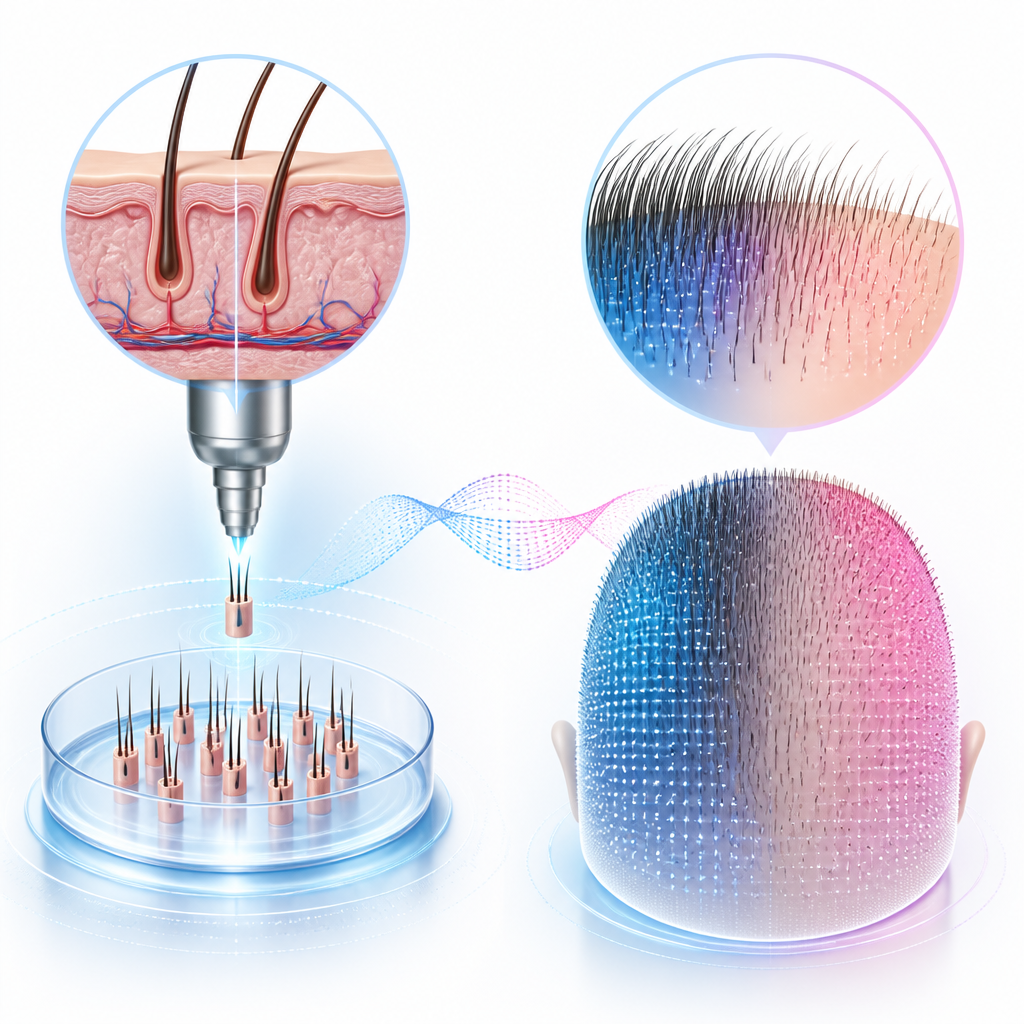
To implement an intricate design, the surgeon must choose the most appropriate harvest and implantation methodologies. The two primary techniques are Follicular Unit Extraction (FUE) and Follicular Unit Transplantation (FUT). Each approach has distinct implications for the survival rate and placement precision of the delicate single-hair grafts needed for the ultra-fine anterior transition zone.
| Technique | Key Advantage | Key Limitation | Best Suited For |
|---|---|---|---|
| Follicular Unit Extraction (FUE) | No linear scar, allowing for short hairstyles; highly selective extraction of fine single hairs. | Higher overall cost; requires longer extraction time; slightly lower graft survival rate in inexperienced hands. | Moderate hairline lowering, patients prioritizing rapid recovery and minimal scarring. |
| Follicular Unit Transplantation (FUT) | Maximizes graft survival rate; provides high volumes of healthy, intact follicular units quickly. | Leaves a permanent linear scar in the donor region; requires trichophytic closure to minimize scar visibility. | Extensive hair restoration, patients with limited donor hair density requiring maximum graft yield. |
According to official guidelines and academic evidence from the International Society of Hair Restoration Surgery (ISHRS, 2021), both quantitative graft placement density and precise anatomical angle alignment must be reviewed together for a successful outcome.
What Critical Factors Guide the Final Design and Surgical Strategy?
When engineering a natural hairline, the surgical team focuses on several highly technical variables. The most critical is the creation of a ‘soft’ anterior border. Placing thick, twoor three-hair follicular units at the very front of the hairline is the leading cause of an artificial appearance. Instead, a meticulous selection of the finest single-hair grafts, often harvested from the lower neck or behind the ears, must be placed randomly but purposefully in a micro-zigzag pattern. This mimics the natural irregularity observed in nature.
Another major factor is the implantation angle. Natural frontal hair does not grow straight out from the scalp; it emerges at a shallow angle of 10 to 20 degrees, pointing forward and downward, following the natural curvature of the forehead. In the temporal recess area, these angles shift laterally and downwards. If the surgeon fails to align the recipient slits to these exact angles, the resulting hair will grow upward or outward, making it impossible to style naturally. However, outcomes may differ in exceptional cases such as patients with severe cicatricial alopecia or advanced keloidal scarring tendencies where tissue perfusion is significantly compromised, limiting the maximum achievable placement density.
Before proceeding with surgical intervention, a patient should undergo a comprehensive diagnostic evaluation. To help determine the appropriate course of action, review the following checklist and the clinical decision flow below:
- Evaluate the stability of the donor hair density and check for active diffuse thinning.
- Analyze the symmetry and proportions of the forehead under both static and dynamic facial movements.
- Assess scalp laxity if an FUT harvest is being considered to prevent donor area tension.
- Formulate a medical management plan (e.g., finasteride or minoxidil) to preserve non-transplanted native hair.
- Align patient expectations regarding density, as transplanted hair cannot perfectly replicate pre-loss native density in a single session.
Clinical Decision Flow Chart:
- Step 1 (Assessment): If the patient has active, rapidly progressing hair loss, then initiate medical stabilization therapy for at least 6 to 12 months before scheduling surgery.
- Step 2 (Planning): If hair loss is stable and donor density is high, then design a customized hairline contour utilizing single-hair micro-grafts for the anterior transition zone.
- Step 3 (Execution): If scalp laxity is excellent and maximum density is required, proceed with FUT; if the patient prefers no linear scar and quick recovery, proceed with FUE.
Frequently Asked Questions FAQ
QHow long does it take for a transplanted hairline to look completely natural?
After the procedure, the transplanted hairs enter a shedding phase within 2 to 4 weeks, which is a normal physiological reaction. New hair growth begins around month 3, with noticeable aesthetic improvements visible by month The final, natural-looking result, featuring fully matured hair texture and thickness, is typically achieved between 12 to 18 months post-surgery.
QCan a poorly designed, unnatural hairline from a previous transplant be corrected?
Yes, corrective hair restoration is possible. Unnatural results can be revised by extracting misplaced, thick grafts using micro-FUE punches, redistributing them, and transplanting fine, single-hair grafts in a natural, soft gradient at the front. Laser hair removal can also be used to adjust an incorrectly positioned hairline.
QWhat is the average survival rate of transplanted hair follicles?
According to clinical data compiled by the ISHRS (2021), modern hair transplantation techniques performed by experienced specialists yield a graft survival rate of over 90% to 95%. This high success rate relies heavily on the careful handling of grafts, maintaining proper hydration, and minimizing the time follicles spend outside the body during the procedure.
QWill I need to continue taking hair loss medication after receiving a hairline transplant?
Yes, continuing medical therapy is highly recommended. While the transplanted hair follicles harvested from the permanent donor zone are genetically resistant to DHT (dihydrotestosterone), your native hairs behind the transplanted zone remain susceptible to progressive androgenetic alopecia. Medication prevents progressive recession, maintaining a seamless blend over time.
This content is general medical information, and individual treatment decisions should be made through imaging tests and in-person medical evaluation.
Author: Medical content editor based on medical information research
Reviewed by: Specialist consultation from the relevant department
Last reviewed: 2026-07-09
Reference guideline: 2021 International Society of Hair Restoration Surgery (ISHRS) Guidelines
Medical neutrality and closing note
The core of medical decision-making is not to follow a specific device or a trending procedure, but to choose an option that fits each patient’s individual anatomy, condition, risk level, and treatment goals. Every procedure has both advantages and limitations, so decisions should be made after sufficient discussion with an experienced specialist.
[Medical information and copyright notice]
This content is a professional medical column prepared based on medical consultation from 제이케이성형외과의원.
The infographics used in this article are created to support understanding and may differ from actual clinical results.
The information provided is a general medical guideline, and accurate diagnosis and treatment require an in-person evaluation by a qualified specialist.