How Do You Compare Breast Implant Types? A Clinical Guide on Cohesive Gels, Textures, and Capsular Contracture Risks
Why is Breast Implant Selection More Than Just Choosing the Desired Volume?
In modern plastic surgery, selecting the appropriate breast implant extends far beyond basic volume preferences. Patients seeking breast augmentation often face choices between different shell textures, gel cohesive properties, and profiles. A mismatch between the implant’s physical characteristics and the patient’s native tissue dynamics can lead to complications such as displacement, unnatural movement, or tissue thinning. Therefore, understanding the underlying bio-material properties is essential for achieving a highly natural, safe, and durable outcome.
Treatment timing: Implant selection and placement planning must occur during the initial clinical consultation, utilizing quantitative soft-tissue measurements such as the pinch test and breast base width.
Non-surgical care: Early-stage post-operative tissue tightening or mild capsular contracture (Baker Grade I and II) can be managed with conservative treatments, including manual compression therapy and targeted pharmacological interventions.
Treatment selection: The choice between smooth, micro-textured, or cohesive gel implants is guided by the patient\’s native parenchymal thickness, lifestyle, and chest wall anatomy to minimize mechanical stress.
What is the Anatomical and Pathophysiological Mechanism of Capsular Contracture?
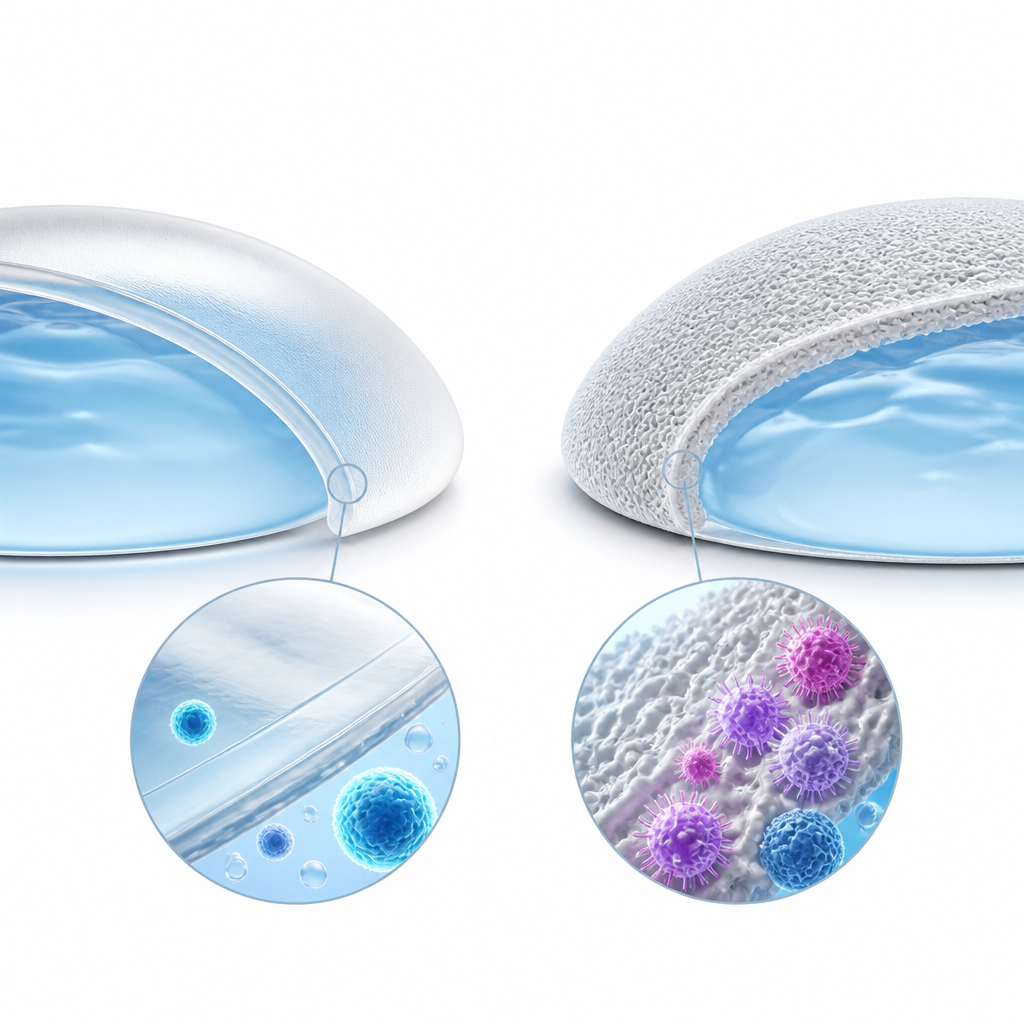
Capsular contracture is an immunologically mediated fibrotic reaction where the body forms a pathological collagen capsule around a foreign object, progressively squeezing the implant and causing hardness, distortion, and pain. When a foreign material is introduced into the breast pocket, the host immune system naturally initiates a foreign body response. In normal circumstances, a thin, flexible collagen envelope forms. However, when chronic subclinical inflammation, bacterial biofilms, or excessive shear stress occur, fibroblasts are continuously activated, transforming into myofibroblasts that deposit dense, disorganized collagen fibers that contract over time.
According to multiple observational studies and meta-analyses, particularly a landmark study published in the Aesthetic Surgery Journal (2021), the incidence of capsular contracture is closely linked to both the implant\’s surface roughness and the surgical pocket environment. For patients experiencing early-stage tissue hardening (Baker Grade I or II), non-surgical conservative strategies are highly reasonable. These include manual manipulation, physical therapy, and the use of leukotriene receptor antagonists (such as montelukast) to stabilize the fibrotic membrane. However, once the condition progresses to Grade III or IV—characterized by visible asymmetry or persistent pain—surgical intervention via capsulectomy is usually required.
How Do Different Implant Textures and Gels Perform Under Clinical Guidelines?
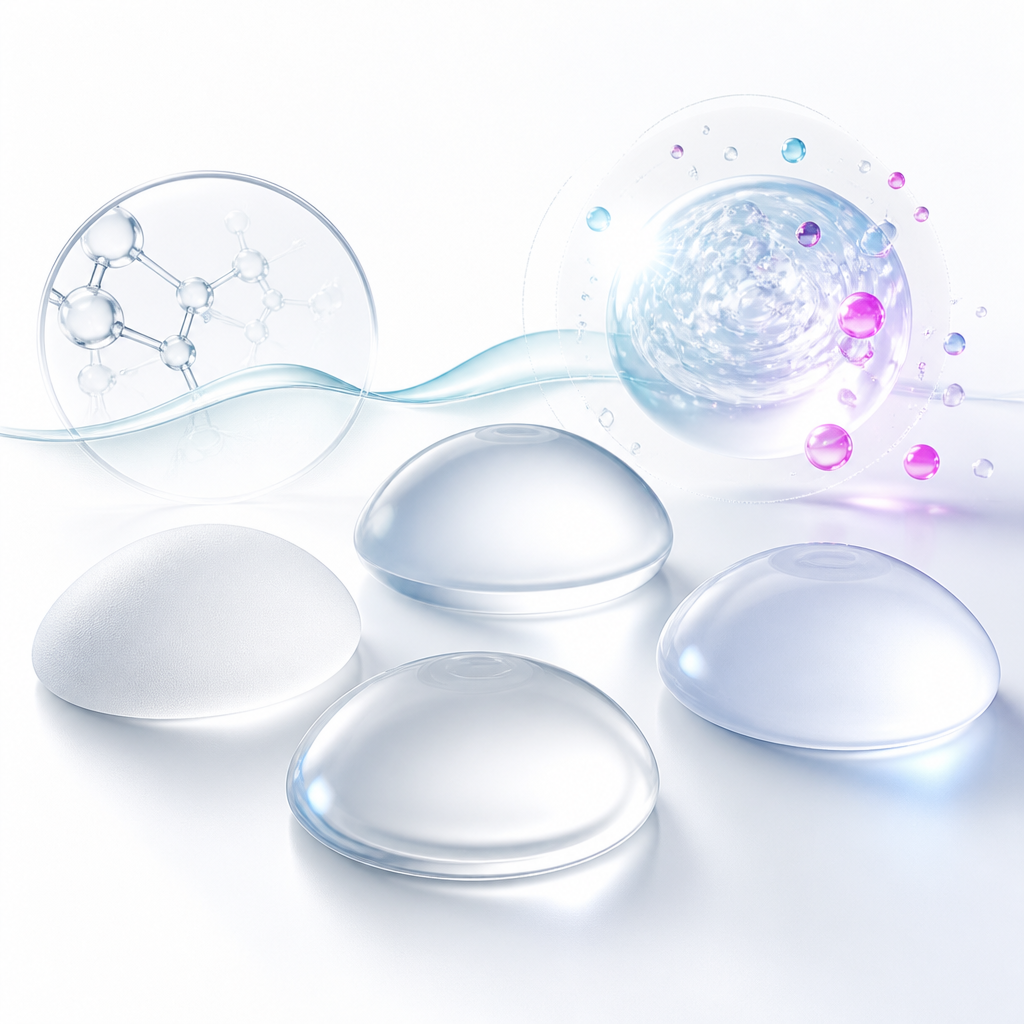
The choice between smooth and micro-textured shells, as well as highly cohesive gels, must be made based on clinical performance metrics. Each implant type presents unique biochemical profiles and mechanical characteristics that influence integration with the surrounding breast tissue.
| Implant Category | Surface Topology | Primary Advantage | Primary Limitation |
|---|---|---|---|
| Smooth Implants | Ultra-smooth shell surface | Highly natural movement and soft feel | Higher long-term risk of displacement or pocket enlargement |
| Micro-textured | Micro-fine textured shell | Reduced capsular contracture rates without high-roughness risks | Requires highly precise pocket dissection to avoid malposition |
| Cohesive Gel | Highly cross-linked silicone | Excellent shape retention and low risk of gel migration if ruptured | Slightly firmer feel compared to lower-viscosity traditional gels |
While modern micro-textured implants are engineered to minimize cellular friction, clinical data from international registries suggest that smooth implants placed in a dual-plane position also demonstrate exceptionally low rates of contracture when strict aseptic techniques, such as triple-antibiotic pocket irrigation, are utilized. However, outcomes may differ in exceptional cases such as patients with severe chest wall deformities, pre-existing autoimmune connective tissue diseases, or those who have undergone prior chest wall radiation therapy, where tissue compliance is compromised.
According to official guidelines from the International Society of Aesthetic Plastic Surgery (ISAPS), both quantitative soft tissue parameters and patient-specific anatomical characteristics must be reviewed together to minimize the risk of mechanical failure or long-term revision surgery.
What is the Clinical Selection Protocol for Your Perfect Fit?
To ensure a highly predictable and safe outcome, the clinical team at 제이케이성형외과의원 utilizes a standardized protocol. This diagnostic framework measures multiple physiological aspects of the patient\’s breast tissue to select the optimal implant shape, texture, and volume:
- Anterior Pinch Test: Measures the thickness of the upper pole subcutaneous tissue to determine if submuscular placement is required for adequate implant coverage.
- Breast Base Width (BBW): Dictates the maximum allowable diameter of the implant to prevent lateral displacement or unnatural merging of the breasts (symmastia).
- Parenchymal Compliance: Assesses the elasticity of the skin and glandular tissue to determine the maximum safe projection profile.
- Lifestyle and Physical Activity: Highly active individuals are often better suited for implants that minimize shear stress and friction during motion.
This comprehensive checklist forms the foundation of a 3-step clinical decision-making flow:
Step 1: If the patient\’s pinch test is less than 2.0 cm, then a submuscular or dual-plane placement is indicated to provide sufficient soft-tissue coverage and avoid visible rippling.
Step 2: If tissue laxity is present along with mild breast ptosis, then a highly cohesive, high-profile implant can be utilized to achieve a natural lifting effect without a full mastopexy.
Step 3: If early-stage capsular contracture (Baker Grade II) is detected post-operatively, then conservative management consisting of ultrasound-guided lymphatic massage and oral leukotriene antagonists is initiated before considering surgical capsulectomy.
Frequently Asked Questions FAQ
QHow long do modern cohesive silicone gel breast implants typically last?
Modern cohesive gel breast implants are highly durable and do not have a pre-determined expiration date. However, they are not permanent medical devices. According to clinical data, the probability of requiring an implant replacement or revision due to capsular contracture, gel aging, or silent rupture increases by approximately 1% to 1.5% annually after the 10-year mark. Regular ultrasound screening is recommended starting 3 to 5 years post-surgery.
QWhat is the difference between smooth and micro-textured implants regarding post-operative recovery?
Smooth implants allow for more natural fluid movement within the surgical pocket and often require structured post-operative massage protocols to maintain the pocket\’s dimensions. Micro-textured implants, on the other hand, are designed to interface closely with the surrounding tissue to prevent displacement. Consequently, they do not require aggressive post-operative massaging, making early recovery more comfortable for many patients.
QCan capsular contracture be resolved completely without undergoing another surgery?
Yes, if diagnosed early. Baker Grade I and II contractures, which manifest as mild firmness or slight tension, can often be managed successfully using conservative, non-surgical methods. This includes specialized manual massage, ultrasound therapy to soften the tissue, and prescription anti-inflammatory or anti-fibrotic medications. However, severe Baker Grade III or IV contractures require surgical intervention.

This content is general medical information, and individual treatment decisions should be made through imaging tests and in-person medical evaluation.
Author: Medical content editor based on medical information research
Reviewed by: Specialist consultation from the relevant department
Last reviewed: 2026-07-07
Reference guideline: 2022 American Society of Plastic Surgeons (ASPS) Clinical Practice Guidelines
Medical neutrality and closing note
The core of medical decision-making is not to follow a specific device or a trending procedure, but to choose an option that fits each patient’s individual anatomy, condition, risk level, and treatment goals. Every procedure has both advantages and limitations, so decisions should be made after sufficient discussion with an experienced specialist.
[Medical information and copyright notice]
This content is a professional medical column prepared based on medical consultation from 제이케이성형외과의원.
The infographics used in this article are created to support understanding and may differ from actual clinical results.
The information provided is a general medical guideline, and accurate diagnosis and treatment require an in-person evaluation by a qualified specialist.